Aramis Capital
What Conviction in Investing Requires | Aramis Capital
What Conviction in Investing Actually Requires
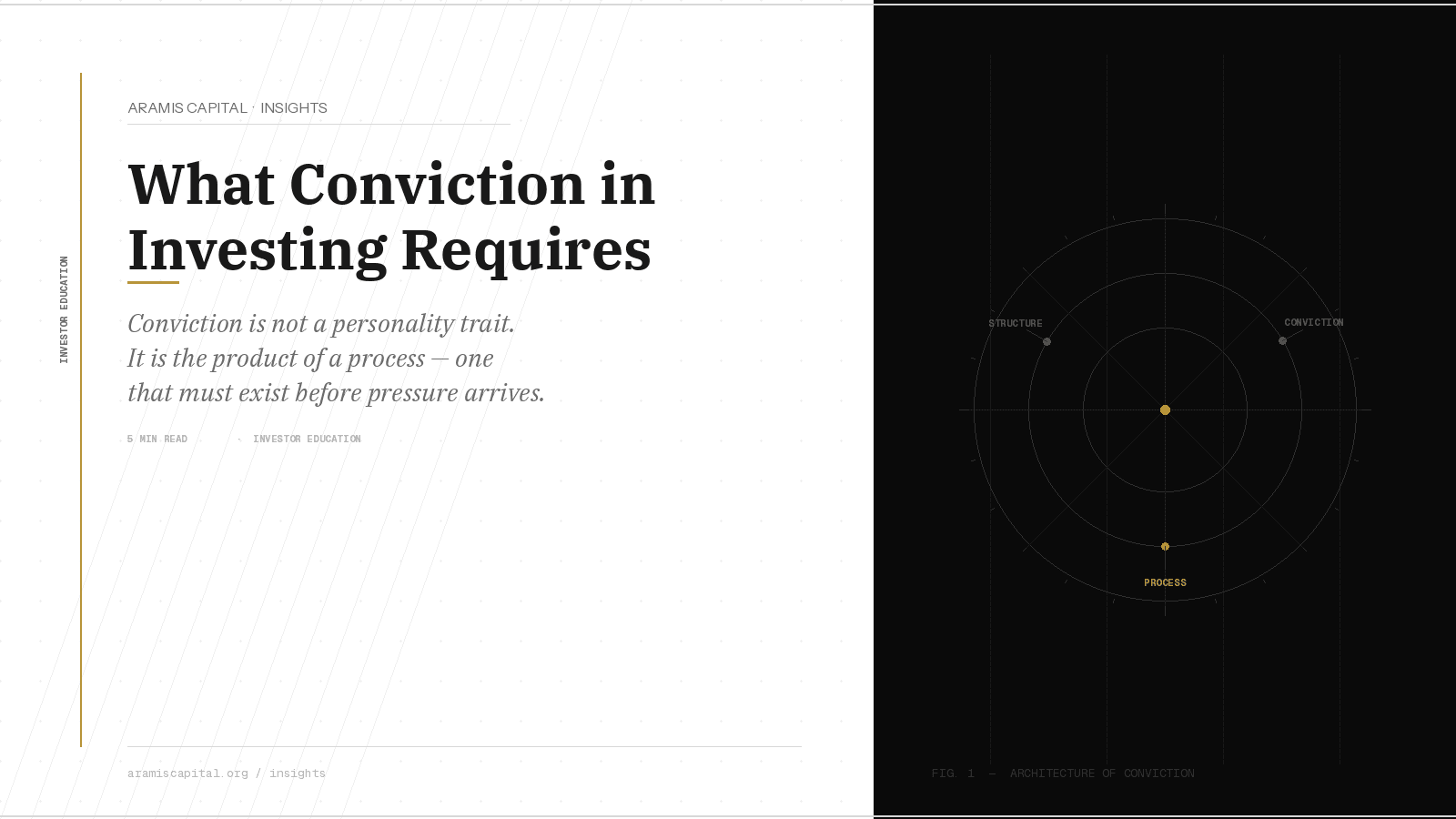
Conviction in investing is almost always the product of a process. Without it, even well-reasoned positions rarely survive short-term pressure.
Conviction in investing is often described as though it were a quality that certain investors naturally possess. Some are considered disciplined, patient, and able to hold positions through difficulty. Others are described as reactive, emotional, or susceptible to short-term noise.
This framing is intuitive, but it is also incomplete.
In practice, the investors and institutions that demonstrate the most durable conviction are not necessarily those with greater certainty about outcomes. They are the ones who have built the processes that make conviction possible — processes that exist independently of the conditions in which they operate.
The gap between intention and behaviour
Most investors articulate long-term objectives with genuine clarity. The intention to remain patient, to think across cycles, and to avoid reactive decisions is not difficult to state. It is widely understood to be the correct approach.
The difficulty lies in execution. When markets decline sharply, when negative information becomes persistent, or when short-term uncertainty rises, the behaviour of many investors diverges from the stated objective. Decisions described as long-term begin to reflect a much shorter time horizon. Positions are reconsidered not because the underlying thesis has changed, but because the discomfort has intensified.
This gap between intention and behaviour is not primarily a discipline problem. It is a structural one. When investment decisions are not anchored to a documented framework, they become vulnerable to the environment they are made in. The framework that exists only as a general intention offers far less protection than one that is written down.
Why documentation matters
One of the more underappreciated practices in institutional investment management is the written investment thesis. Before a position is established, the rationale is articulated — the reasoning, the expected time horizon, the assumptions on which the thesis depends, and the conditions under which it would no longer apply.
This process serves a function that goes beyond record-keeping. When a position comes under pressure and discomfort rises, the written thesis provides a reference point that is independent of the current moment. It allows the investor to ask a more precise question: has the thesis changed, or have the conditions simply become more uncomfortable?
Without that reference point, every piece of negative information carries more weight than it should. The absence of documentation means the evaluation is conducted in real time, under pressure, without a baseline — which is precisely when reasoning is most unreliable.
Conviction as a product of process
What this suggests is that conviction is not something investors either have or do not have. It is something that can be built through process — and, equally, something that process can erode if it is poorly designed.
A portfolio that is constructed with clear documentation, defined time horizons, and explicit conditions for review is one where conviction has structural support. Changes are considered against the original rationale, not against the most recent performance.
A portfolio without that structure is one where every piece of information is equally relevant, and where the decision to hold or exit is evaluated fresh each time conditions shift. In this environment, conviction tends not to survive difficulty, regardless of how strongly it was felt at the outset.
The implication for long-term investing
This has a practical consequence for investors who genuinely want to operate with long-term time horizons.
The intention to invest long-term is not sufficient on its own. Long-term investing requires the structure to hold that intention in place when short-term conditions make it uncomfortable. That structure is not built in the moment — it is built before the pressure arrives.
The investors and institutions that compound over extended periods are not those who are immune to uncertainty. They are the ones who have designed the process by which uncertainty is absorbed without displacing the original strategy.
Conviction, in this sense, is not a temperament. It is an architecture.
Conviction is not a personality trait. It is a product of process — and without that process, long-term intentions rarely survive short-term pressure.

Disclaimer
Aramis Capital provides investment-related information for general informational purposes only. Nothing on this website constitutes financial, legal, or investment advice, nor should it be relied upon as such. Past performance is not indicative of future results. All investments involve risk, including the possible loss of capital.
Services and products described on this website are subject to applicable laws and regulatory requirements and may not be available to all investors or in all jurisdictions.
© 2026 Aramis Capital. All Rights Reserved.