Aramis Capital
Research Desk
Investor Education
The Gap Between Activity and Progress in Investing
"Most investors confuse activity with progress. In the short term they look identical — but over time, the distinction shapes investment outcomes."
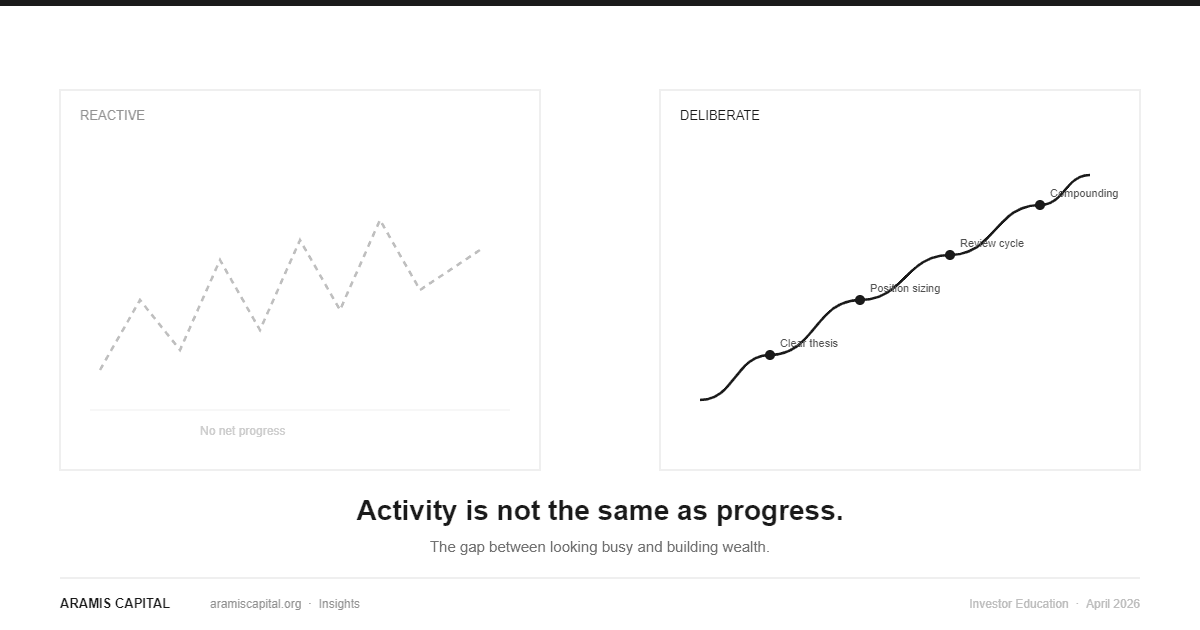
There is a pattern that emerges quietly in many investment journeys. Capital is deployed. Markets move. Adjustments are made. The cycle continues. From the outside — and often from the inside — this looks like active, engaged portfolio management. In many cases, however, it is something else entirely.
The distinction between purposeful activity and reactive behaviour is one of the most important, and least discussed, concepts in investing. Both involve making decisions. Both involve monitoring performance. Both can generate the feeling of being in control. But their long-term consequences can diverge significantly.
Purposeful activity is grounded in structure. It begins with a clear investment objective and a defined time horizon. Decisions are made within an established framework, and performance is evaluated against long-term outcomes rather than short-term movements. When conditions change, the response is measured and consistent with the original strategy.
Reactive behaviour, by contrast, is driven by discomfort. It tends to increase in frequency when markets are volatile, when news flow is heavy, or when short-term results diverge from expectations. The decisions it produces may feel logical in the moment, but they are often disconnected from any coherent long-term framework. Over time, this creates drag — not through any single mistake, but through the accumulated cost of many small, unnecessary interventions.
The challenge is that the two are not always easy to distinguish. Rebalancing a portfolio is a structured activity. So is reducing exposure to a sector experiencing fundamental deterioration. But selling during a market downturn because the movement feels threatening, or adding to a position because of short-term momentum, are reactive decisions — even when they are rationalised as strategic.
Institutional investors spend considerable time designing systems that separate these two modes of behaviour. Investment policies, governance frameworks, and decision-making protocols are not bureaucratic formalities. They are mechanisms for ensuring that action is taken for the right reasons, not simply in response to the right feelings.
For individual investors, the equivalent is clarity of purpose. Understanding why capital is allocated in a particular way, what time horizon it is intended to serve, and what conditions would genuinely warrant a change — these questions do not eliminate uncertainty, but they provide a framework for navigating it. Without that framework, activity can easily substitute for progress, often at a cost that only becomes visible in retrospect.
The goal is not to eliminate action. It is to ensure that action is taken deliberately — and that inaction, when appropriate, is recognised as a decision in its own right.
Activity isn't progress. The most valuable investing skill is distinguishing deliberate strategy from reactive behaviour.
Disclaimer
Aramis Capital provides investment-related information for general informational purposes only. Nothing on this website constitutes financial, legal, or investment advice, nor should it be relied upon as such. Past performance is not indicative of future results. All investments involve risk, including the possible loss of capital.
Services and products described on this website are subject to applicable laws and regulatory requirements and may not be available to all investors or in all jurisdictions.
© 2026 Aramis Capital. All Rights Reserved.